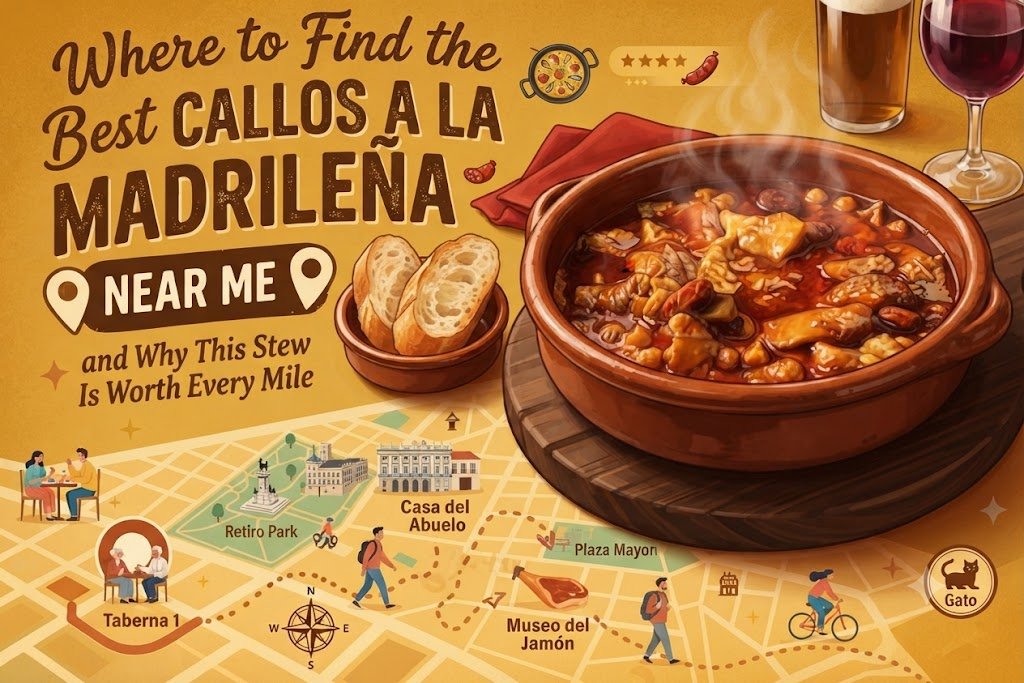

There’s a moment — if you’ve ever been lucky enough to eat callos in a proper Madrid tasca — where the smell hits you before the bowl does. Paprika, chorizo, slow-rendered fat, something deep and mineral from the tripe itself. Your brain says “simple stew.” Your stomach immediately disagrees.
Callos a la madrileña is one of those dishes that sounds humble on paper and hits like a revelation on the plate. It’s beef tripe — the lining of the cow’s stomach — slow-cooked for hours with morcilla (blood sausage), chorizo, cured ham, garlic, and smoked paprika until it becomes something altogether greater than its parts. Thick, glossy, deeply spiced sauce. Tripe so tender it almost dissolves. A warmth that starts in your chest and radiates outward.
Madrid has been eating this dish since the 19th century, and the city takes it seriously enough to hold an annual World Tripe Championship. That alone should tell you something.
Whether you’re chasing the real thing on a trip to Spain, hunting for a trustworthy bowl in the UK or USA, or planning to cook it yourself at home — this guide will help you find (or make) callos a la madrileña better than ever.
Where the World’s Best Callos a la Madrileña Can Be Found
Zalacaín — Madrid, Spain
If prestige is what you’re after, Zalacaín is where you start. This legendary restaurant won the IV World Tripe Championship in 2021, and chef Jorge Losa’s recipe is a masterclass in restraint and quality. His ratio — 60% tripe, 20% leg, 20% snout — is the kind of precision you’d expect from a chef who treats offal with the same seriousness as wagyu. Worth every euro.
Sobrino de Botín — Madrid, Spain
Founded in 1725, Botín holds the Guinness World Record as the oldest restaurant still operating in the world. It sits on Calle Cuchilleros in the shadow of Plaza Mayor, and its callos has been on the menu, in some form, for generations. The setting is candlelit, stone-walled, and wonderfully unhurried. Go for lunch when the light comes through the old windows and order a house red to go with it.
Malacatín — Madrid, Spain
This is where Madrileños take their tripe obsession most seriously. Located on Calle de la Ruda in La Latina — the beating heart of traditional Madrid cuisine — Malacatín is famous specifically for its callos. Tables fill fast, the atmosphere is loud and local, and the stew is prepared fresh daily using methods that haven’t changed in decades. No tourists-first energy here. In my experience, this is the kind of place where you find the real soul of a dish.
Lhardy — Madrid, Spain
Founded in 1839, Lhardy is one of those restaurants that’s technically expensive and completely worth it. A portion of callos runs around €28, but you’re eating in a room with 19th-century Rococo décor that once hosted Spanish royalty and literary giants. The dish itself is refined — silkier than the rustic versions, more elegant in its spicing — without losing any of its character.
Taberna San Mamés — Madrid, Spain
This tiny tavern in Argüelles has earned a reputation that Anthony Bourdain once helped amplify. The morcilla here is exceptional — deeply complementary to the tripe in a way that elevates the whole dish. It’s cramped, warm, and has the kind of rule-sheet atmosphere that tells you the kitchen is serious. Food lovers who’ve tried both agree the morcilla-to-tripe balance at San Mamés is something genuinely special.
Casa Alberto — Madrid, Spain
Tucked into the Huertas neighbourhood, Casa Alberto has been feeding Madrileños since 1827. One of the oldest taverns in the city. The callos here is served the old-fashioned way — bubbling in a clay cazuela, arrived at the table with crusty bread already placed beside it like an instruction. No shortcuts.
Best Places in the USA to Find Callos a la Madrileña
The United States has a growing Spanish food scene, particularly in cities with established Iberian communities, but callos is still a dish you have to seek out rather than stumble upon.
Rosa’s Restaurant — Miami, Florida
In Little Havana, Rosa’s has built a reputation on exactly the kind of saucy, slow-cooked Spanish food this dish demands. The callos a la madrileña here features tripe so tender it barely needs a knife, swimming in a thick chorizo-enriched stew that you’ll want to mop clean with the free bread they bring to the table. Miami food writers at The Infatuation have specifically called out this dish as a reason to visit. Go in the cooler months — even Miami winters make this stew feel right.
Café Ba-Ba-Reeba! — Chicago, Illinois
Located on N Halsted Street in Lincoln Park, Café Ba-Ba-Reeba! is one of Chicago’s most established Spanish restaurants and a serious stop for anyone hunting traditional Spanish stews in the Midwest. The menu rotates seasonally, and callos appears as a cold-weather special — worth calling ahead to confirm it’s on. The Spanish wine selection here is genuinely impressive.
Spanish Tapas Bars in NYC’s Hell’s Kitchen & Chelsea
New York doesn’t have one single standout destination for callos the way Miami or Madrid does, but the concentration of authentic Spanish-chef-led restaurants in Hell’s Kitchen and Chelsea makes these neighbourhoods worth exploring. Look for rotating winter specials and handwritten boards — in New York, that usually means someone back there actually cooks.
Pro tip for the USA: Use Google Maps with the search “callos a la madrileña near me” plus your city name, then filter by rating and check menu photos to confirm the dish is actually on the menu, not just in the restaurant description.
Best Places in the UK for Callos a la Madrileña
London is, without question, the best city in the UK for authentic Spanish food — and increasingly, it punches at Madrid’s level.
Sabor — Mayfair, London
Helmed by Michelin-starred chef Nieves Barragán Mohacho, Sabor is the finest Spanish restaurant in London by most serious measures. The upstairs El Asador section focuses on the slow-cooked, fire-based cooking of Castile and Galicia — the regions most closely tied to callos tradition. When callos a la madrileña appears on the seasonal menu, it is considered by food professionals to be some of the best outside Spain itself. Book the Asador in advance. The counter downstairs is walk-in only.
Barrafina — Soho & Multiple London Locations
Five branches across London now, and still no bookings at the original Dean Street site. The queues are there for a reason. Chef Antonio Gonzales Milla’s menu showcases authentic Spanish cooking, and callos appears as a seasonal special worth waiting for. The marble counter setup makes eating here feel properly Spanish — no fuss, good wine, and extraordinary food served without ceremony.
José Pizarro — Bermondsey Street, London
Chef José Pizarro runs three restaurants on Bermondsey Street, and the original José — a tiny, walk-in-only tapas bar — is the most authentic of the three. Pizarro is a serious Spanish chef with deep ties to traditional Iberian cooking, and his rotating menu often includes rich, slow-cooked dishes that sit alongside callos in spirit if not always by name. Check his current menu online before visiting.
How to find callos near you in the UK: Google Maps, search “callos a la madrileña London” or “traditional Spanish stew near me” and filter results by rating. Check TripAdvisor for recent menu mentions — callos is seasonal, so a review from last winter is more reliable than a general menu listing.
What Is Callos a la Madrileña — and What Makes It Good?
Callos a la madrileña is a traditional Madrid tripe stew, deeply rooted in the city’s working-class food history. Born out of necessity — using the parts of the animal that more expensive cuts left behind — it evolved over centuries from humble tavern food into one of the most celebrated dishes in Spanish gastronomy.
Core ingredients:
- Beef tripe (the star — must be properly cleaned and slow-cooked)
- Chorizo (adds fat, spice, and smokiness)
- Morcilla / blood sausage (earthy, rich, essential)
- Jamón / cured ham
- Pig’s trotters or snout (adds gelatin and body to the sauce)
- Smoked paprika (pimentón)
- Garlic, onion, tomato, bay leaves, white wine
A great version has sauce that coats a spoon but pours smoothly — deep reddish-brown, not bright red. The tripe should be tender but not mushy, holding just enough chew. A poor version has watery broth, rubbery tripe, or the kind of sharp paprika heat that masks rather than complements.
How to Make Callos a la Madrileña at Home — Step by Step
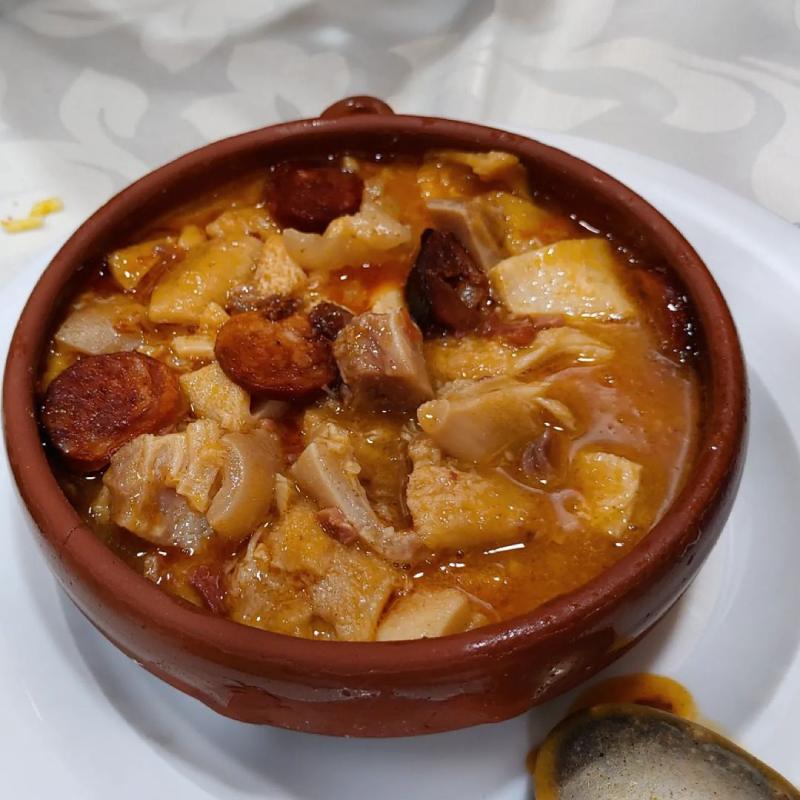
Prep time: 30 minutes | Cook time: 3–3.5 hours | Serves: 4–6
Ingredients:
- 800g beef tripe, cleaned
- 200g chorizo, sliced into rounds
- 150g morcilla, sliced
- 100g cured ham (jamón serrano), diced
- 1 pig’s trotter, split (optional but recommended)
- 1 large onion, finely diced
- 4 garlic cloves, minced
- 2 ripe tomatoes, grated
- 2 tbsp smoked paprika (pimentón de la Vera)
- 1 tsp hot paprika or a dried guindilla chili
- 150ml white wine
- 500ml chicken or beef stock
- 2 bay leaves
- Salt and black pepper
- Olive oil
Steps:
- Clean and blanch the tripe. Rinse thoroughly under cold water. Place in a large pot, cover with cold water, bring to the boil, and discard the water. This removes any residual odour. Cut the tripe into roughly 4cm pieces.
- Build the base. In a large heavy-bottomed pot or Dutch oven, heat 3 tbsp olive oil over medium heat. Add the onion and cook slowly for 10 minutes until soft and golden — don’t rush this step, it forms the flavour backbone.
- Add the aromatics. Stir in the garlic and cook for 2 minutes. Add the grated tomatoes, smoked paprika, and hot paprika. Cook for 4–5 minutes until the tomato darkens and the paprika is fragrant. Pro tip: Never add paprika to dry heat — it burns in seconds and turns bitter. Always cook it in oil or wet ingredients.
- Deglaze and build the stew. Pour in the white wine, scraping up any bits from the bottom. Add the tripe, pig’s trotter, ham, chorizo, morcilla, bay leaves, and stock. The liquid should just cover everything — add water if needed.
- Slow cook. Bring to a gentle simmer, cover, and cook on low heat for 2.5–3 hours. Stir occasionally. The tripe is ready when it yields easily to a fork but still has a slight chew. Common mistake: Cooking on too high a heat. The stew should barely bubble — a rolling boil will tighten the tripe instead of tenderising it.
- Adjust and rest. Season with salt, taste for paprika balance, and let the stew rest uncovered for 20–30 minutes before serving. It thickens beautifully as it cools slightly. Pro tip: Like most braises, this dish is genuinely better the next day. Make it ahead.
- Serve. Ladle into deep bowls or clay cazuelas. Serve with plenty of crusty white bread and a glass of Ribera del Duero or a cold caña (small beer). Do not skip the bread — soaking up that sauce is half the experience.
FAQ — Real Questions, Straight Answers
What is callos a la madrileña made of? The dish is built around beef tripe slow-cooked with chorizo, morcilla (blood sausage), cured ham, smoked paprika, garlic, onion, and tomato. Some recipes add pig’s trotters or snout, which release gelatin and give the sauce that thick, glossy body that separates a great version from a mediocre one.
Is callos a la madrileña available year-round? Technically yes, but demand and quality peak from October through April. It’s a cold-weather dish at heart — rich, warming, and deeply satisfying on a grey afternoon. Many restaurants, especially outside Spain, feature it as a seasonal special rather than a permanent menu item.
How do I know if a restaurant is serving authentic callos a la madrileña? Look for a deep reddish-brown sauce (not bright red), tripe that’s fork-tender without being mushy, and a rich aroma when the bowl arrives. It should be served piping hot, ideally in a clay cazuela. Watery broth or rubbery tripe are the two biggest red flags.
What’s the best wine to pair with callos a la madrileña? A full-bodied Spanish red is ideal — Ribera del Duero or a solid Rioja. The tannins cut through the dish’s richness perfectly. If you’re not drinking wine, a cold small beer (caña) works just as well and is what most Madrileños would order.
Can I make callos a la madrileña without morcilla? You can, but the dish loses something — morcilla adds an earthy depth that chorizo alone doesn’t replicate. If you can’t find morcilla locally, look in Spanish or Portuguese food shops, or try a good quality black pudding as a substitute. It’s not identical but closer than skipping it entirely.
How should I search for callos a la madrileña near me if I’m not in a big city? Try Google Maps with “Spanish restaurant traditional” or “Madrid tripe stew” combined with your city or the nearest large city. TasteAtlas is also an excellent resource used by food professionals — their rankings for this dish are reliable. And if you can’t find it nearby, honestly? Make it at home. This recipe rewards the effort.
Conclusion
Callos a la madrileña is one of those dishes that asks a little trust from you before it delivers. It’s offal. It’s slow-cooked. It doesn’t look glamorous. But from the taverns of La Latina to a bowl made in your own kitchen on a January evening, it consistently delivers the kind of deep, satisfying warmth that flashier dishes rarely manage.
Whether you’re planning a trip to Madrid to try it at Malacatín or Botín, hunting for an authentic version at Sabor in London or Rosa’s in Miami, or simply ready to spend a Sunday afternoon slow-cooking something genuinely special — the best callos a la madrileña near me and near you is closer than you think.
Go find it. Or better yet — make it yourself. That pot on the stove, filling your kitchen with the smell of paprika and chorizo, might just become your new Sunday ritual.
Read More Blog:
Best Pretzel with Cheese Dip Near Me
Best Sancocho Colombiano Near Me